


























Views
Plays
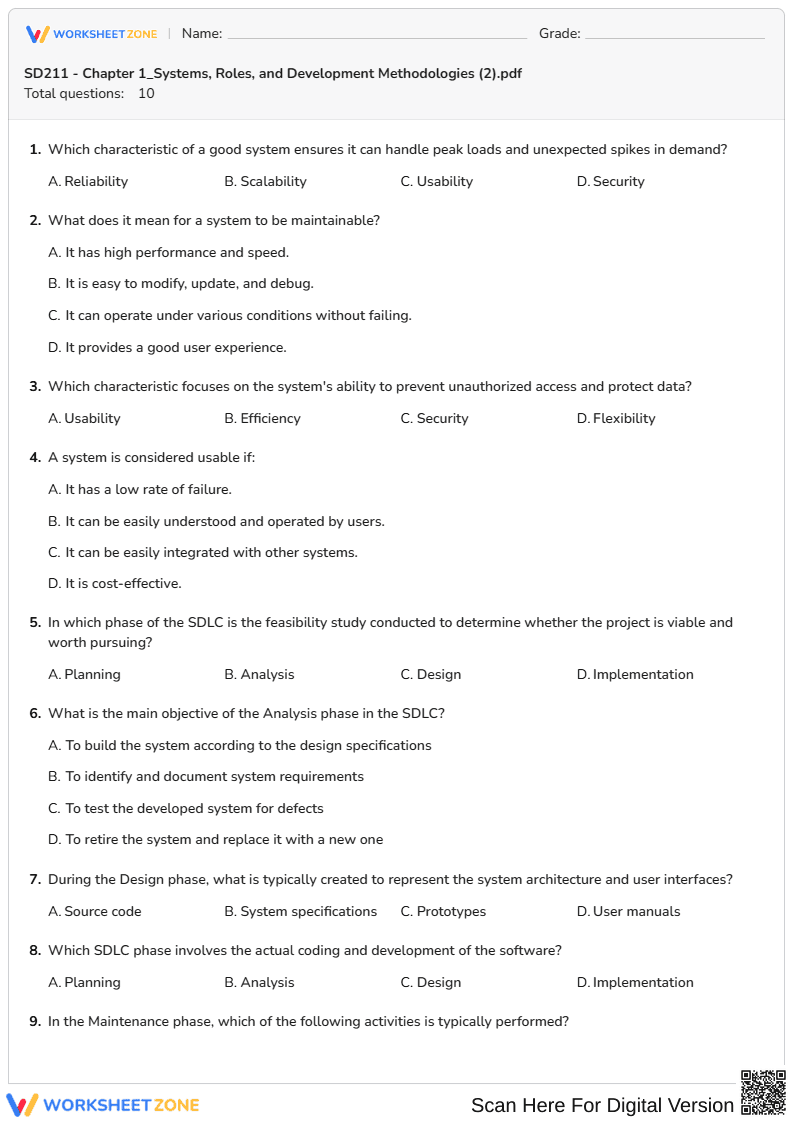
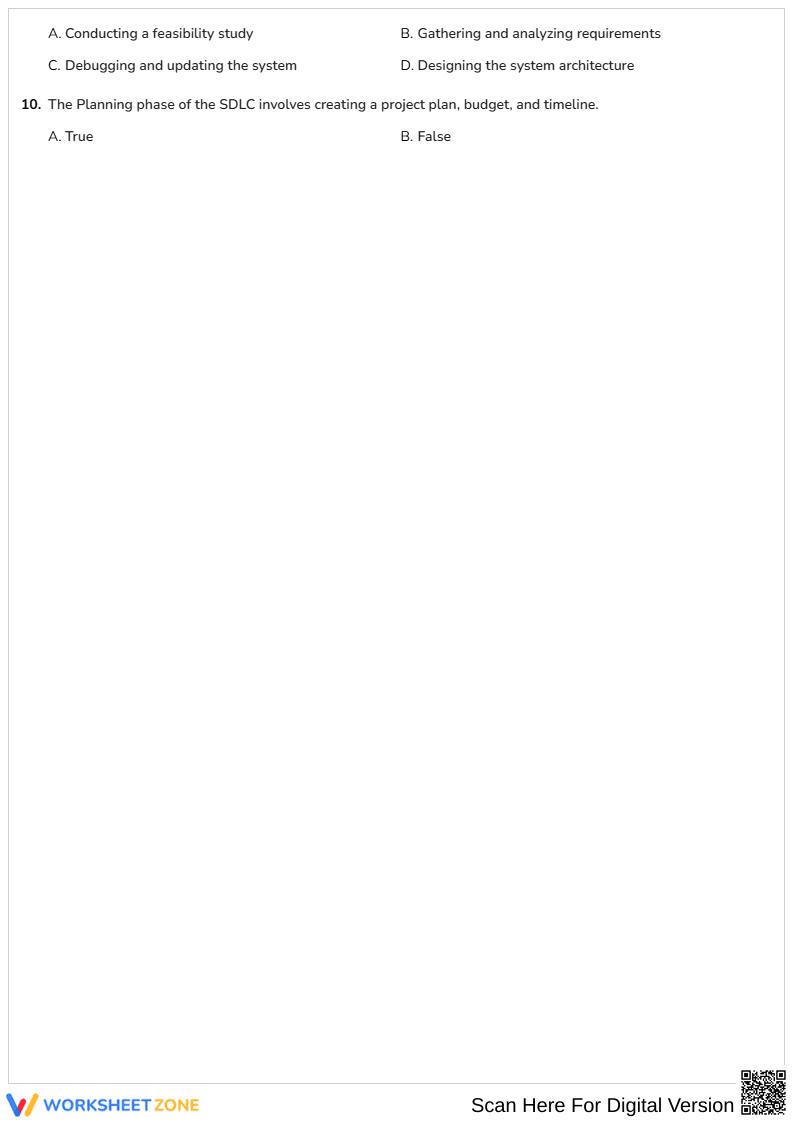

SDLC & Systems Quiz | Printable Grade 10-12 Worksheet
Paste this activity's link or code into your existing LMS (Google Classroom, Canvas, Teams, Schoology, Moodle, etc.).
Students can open and work on the activity right away, with no student login required.
You'll still be able to track student progress and results from your teacher account.
This Grade 10-12 computer science worksheet evaluates student understanding of the Systems Development Life Cycle (SDLC) and core system characteristics. By completing this quiz, learners will demonstrate their ability to identify key phases like planning, analysis, and design, while defining essential traits such as scalability and maintainability.
At a Glance
- Grade: 10-12 · Subject: Computer Science
- Standard:
CSTA 3A-AP-22— Design and develop computational artifacts using collaborative methodologies- Skill Focus: SDLC Phases and System Characteristics
- Format: 2 pages · 10 problems · Answer key included · PDF
- Best For: Formative assessment or quick review
- Time: 15–20 minutes
Inside this resource, educators will find a streamlined, two-page assessment featuring ten carefully constructed questions. The task types include nine multiple-choice questions and one true/false prompt, covering foundational IT concepts. The layout is clean and highly readable, minimizing distractions so students can focus entirely on recalling and applying their knowledge of system development methodologies. An answer key is included to ensure rapid and accurate grading.
- Print (1 minute): Simply download the PDF and print a class set. The black-and-white design is highly ink-efficient.
- Distribute (1 minute): Hand out the two-page quiz at the start or end of your lesson. No special materials or teacher setup are required.
- Review (3 minutes): Use the included answer key to quickly grade the submissions or conduct a peer-review session. Total teacher prep time is well under two minutes, making this an excellent option for emergency sub plans.
Aligned to CSTA 3A-AP-22, this resource supports the standard: "Design and develop computational artifacts working in team roles using collaborative tools." It specifically targets the foundational knowledge required to understand the methodologies (like SDLC) that guide these collaborative development processes. Both standard codes can be copied directly into lesson plans, IEP goals, or district curriculum mapping tools.
This worksheet serves as an ideal formative assessment after direct instruction on the Systems Development Life Cycle. Teachers can assign it as an independent exit ticket to gauge comprehension before moving on to complex project-based learning. Alternatively, use it as a pre-assessment at the start of a software engineering unit to identify baseline knowledge. Expected completion time is 15 to 20 minutes. As a formative observation tip, monitor which specific SDLC phases students struggle to differentiate, such as confusing the Analysis and Design phases.
This resource is designed for high school students in introductory computer science, IT fundamentals, or CTE pathways. The straightforward multiple-choice format provides built-in scaffolding for students who benefit from structured recall options, making it accessible for diverse learners. It pairs perfectly with a direct instruction lesson on software engineering principles or a visual anchor chart detailing the SDLC steps.
Integrating structured assessments on foundational methodologies like the SDLC is critical for developing robust computer science competencies in high school classrooms. Aligned with CSTA 3A-AP-22, this resource helps students design and develop computational artifacts using collaborative methodologies by ensuring they first understand the theoretical frameworks guiding these essential processes. According to a recent ScienceDirect TpT Analysis, providing clear, low-stakes formative assessments significantly improves long-term retention of technical vocabulary and procedural knowledge in STEM education. By isolating specific concepts such as system scalability, maintainability, and the distinct phases of software development, educators can accurately pinpoint instructional gaps early in the unit. This targeted approach ensures that learners build a highly solid conceptual foundation before engaging in complex, collaborative programming projects, ultimately fostering much greater success in advanced computer science coursework and future industry certifications.


